Why Is CO2 Nonpolar? Draw the Dipole Arrows
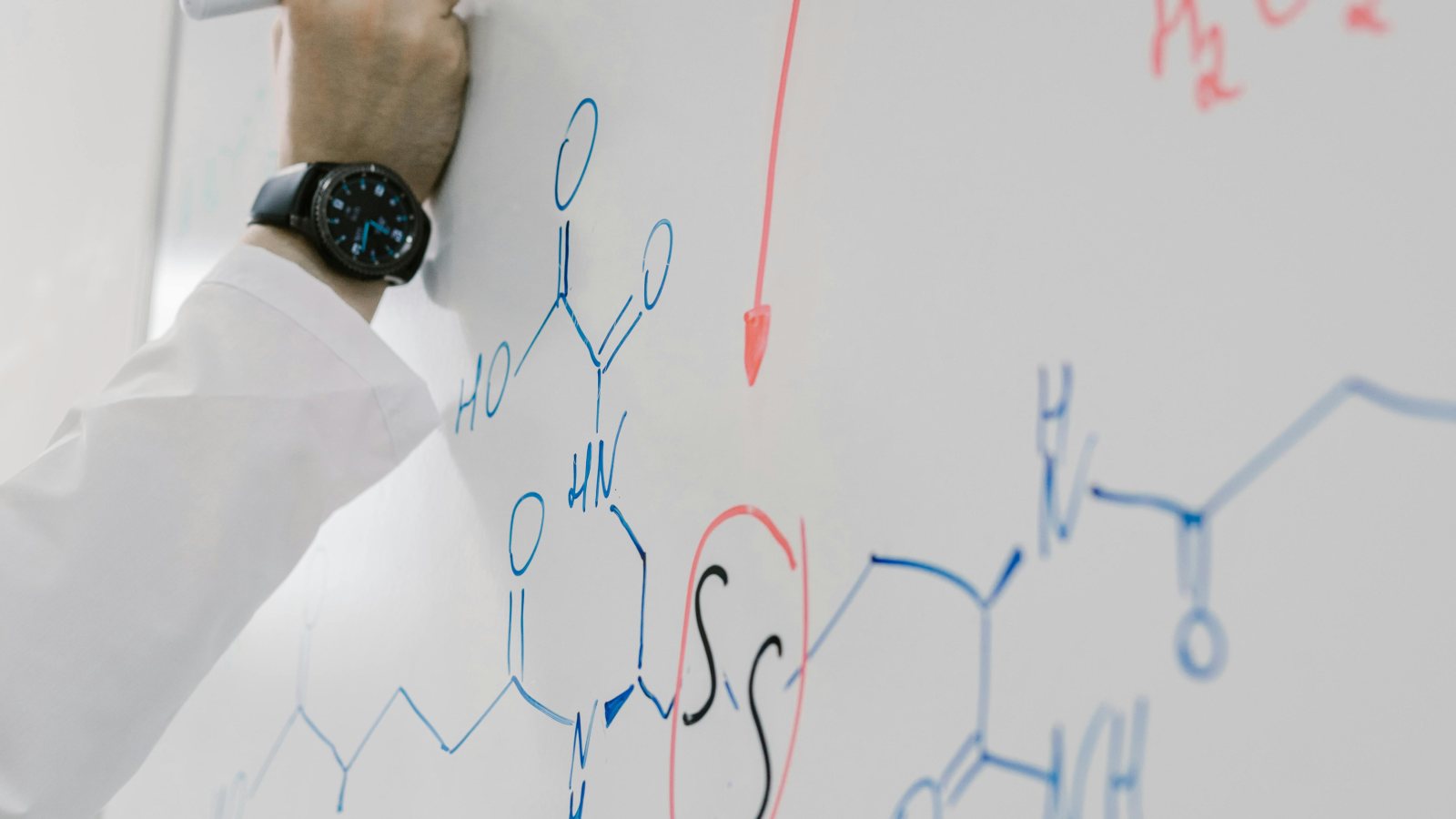
If oxygen pulls electrons toward itself, why is CO2 nonpolar? Try drawing two arrows, one for each carbon-oxygen bond, and then moving the arrows without turning them. In carbon dioxide, the second arrow takes you right back to where you started. In water, it doesn't. That's the difference between having polar bonds and having a polar molecule.
Mark the electron-rich end of each bond
Electronegativity describes how strongly an atom attracts shared electrons in a bond. Oxygen is more electronegative than either carbon or hydrogen. In a C=O bond, the shared electrons are drawn toward oxygen rather than carbon. The same happens in an O-H bond: the oxygen end is partially negative, and the hydrogen end is partially positive. These are partial charges, not the full charges of separate ions.
To show that direction on paper, use the common chemistry convention: draw a bond dipole arrow pointing toward the partially negative end, with a small cross at the positive tail. In CO2, the arrows point away from the central carbon, toward the two outer oxygens. In H2O, they point from the outer hydrogens toward the central oxygen. Make the two arrows equal in length within each drawing because the two bonds in each molecule are equivalent. You don't need to use the same arrow length for both molecules.
Why is CO2 nonpolar when both bonds are polar?
Start with the Lewis structure O=C=O. Each double bond counts as one region of electron density around carbon when you predict the shape. Carbon has no lone pairs in this structure, so there are just two regions around it. They point in opposite directions, giving a linear molecule with a bond angle of 180°.
On a sheet of paper, draw one bond dipole arrow pointing left and the other pointing right. To add them, copy the right-pointing arrow so its tail sits at the tip of the left-pointing arrow. Don't rotate it. If the first arrow takes you three squares left, the second takes you three squares right. Your endpoint is your starting point, so the sum is zero. The three squares are just a drawing scale, not a measured dipole.
That cancellation does not make the C=O bonds nonpolar. It means the molecule as a whole has no permanent dipole. You can see the same result without adding arrows: the two ends of the molecule are equivalent. If you turn the drawing around so the oxygens trade places, there is no way to distinguish one end as the negative end and the other as the positive end.
In water, only part of each arrow cancels
In the Lewis structure of water, oxygen has two O-H bonds and two lone pairs. That gives four regions of electron density around oxygen. Their arrangement is approximately tetrahedral, but the molecular shape describes the positions of the atoms, not the positions of the lone pairs. The atoms form a bent shape, with an H-O-H angle of about 104.5°. The OpenStax explanation of molecular structure and polarity shows how to distinguish the arrangement of electron regions from the shape of the molecule.
Draw the oxygen above the two hydrogens, with one hydrogen to the left and the other to the right. Now draw an arrow from each hydrogen toward oxygen. The arrow from the left points up and right. The arrow from the right points up and left. The sideways parts are equal and opposite, so they cancel. The upward parts point the same way, so they add. Using the same arrow convention, the net arrow points up the middle of the drawing, from the hydrogen side toward the oxygen side.
Try the head-to-tail method on this drawing as well. Copy the up-and-left arrow so it starts at the tip of the up-and-right arrow. Its tip ends directly above the starting point. The arrow from start to finish shows the direction of the net dipole. Rotating the whole drawing would change what's up on the page, but the net arrow would still point toward the oxygen side. This sketch predicts the direction; it does not measure the strength of water's dipole.
Change one feature and redraw the arrows
First, imagine a water molecule forced into a straight line with two equivalent O-H bonds. This is a drawing exercise, not water's actual geometry. Put a hydrogen on either side of oxygen and point both bond arrows inward. One points left, the other right. Now the equal arrows cancel. Comparing that sketch with the bent drawing isolates the effect of the bond angle without changing the atoms or the arrow lengths.
Next, try a real linear molecule with unlike ends: hydrogen cyanide, HCN. Its atoms lie in the order H, C, N. Carbon attracts shared electrons more strongly than hydrogen, and nitrogen attracts them more strongly than carbon. So in a simple bond dipole sketch, the H-C arrow points toward carbon, and the C≡N arrow points toward nitrogen. Both point in the same direction along the line. HCN is polar even though it is linear. The word linear tells you where to draw the bonds, not whether the arrows cancel.
Make the cancellation visible in a written answer
On a chemistry problem, “the molecule is symmetric” may leave the key step unstated. For CO2, write that its two equal C=O bond dipoles point in opposite directions. For H2O, mark the lone pairs, draw the bent shape, and show that the sideways parts of the arrows cancel while the parts along the middle add. A labeled sketch makes it clear that you've used the molecular shape, not just the formula.
For more drawing practice, use the IChC chemistry learning resources or explore the Chemistry Explained articles. On your next polarity problem, sketch the arrows before writing “polar” or “nonpolar,” and check whether moving them tip to tail brings you back to your starting point.
Frequently asked questions
Are the C=O bonds in carbon dioxide nonpolar?
No. Each C=O bond is polar, but the two equal bond dipoles point in opposite directions and cancel.
Why don't the two O-H dipoles in water cancel?
Water is bent, so the two arrows aren't directly opposite. The sideways parts cancel, but the parts pointing toward the oxygen side add.
Does a linear molecule have to be nonpolar?
No. Hydrogen cyanide is linear and polar. A straight arrangement only gives cancellation if the dipoles balance.
About the International Chemistry Competition: an online chemistry competition for high school students from around the world. Qualification Round 2027: submissions are open until Sunday, 3 January 2027. How the rounds work